
Australia’s money transfer and remittance sector has expanded significantly in recent years, driven by a growing migrant population, increasing cross-border trade, and the rapid rise of fintech innovation. As demand for fast, affordable international money transfers grows, so too does the regulatory scrutiny applied to businesses operating in this space.
Before you can legally offer remittance or payment services in Australia, you must register with the relevant authorities and implement a robust compliance framework. Failure to do so exposes your business to significant financial penalties, criminal liability, and reputational damage that can be difficult — if not impossible — to recover from.
Step 1: Understand Whether You Need a Money Transfer Licence
Not every business that moves money is automatically classified as a remittance dealer under Australian law — but the thresholds are broad, and many operators are caught unaware.
Under the Anti-Money Laundering and Counter-Terrorism Financing Act 2006 (AML/CTF Act), any business that provides “designated remittance services” is classified as a reporting entity and must register with AUSTRAC. This includes businesses that:
- Transfer money on behalf of customers (including international transfers)
- Operate as currency exchange services
- Provide digital currency exchange or crypto-asset services
- Act as payment facilitators or settlement agents
If your business model involves any of these activities, you are legally required to enrol and register as a reporting entity before commencing operations. For a detailed breakdown of who needs a licence, see our guide: Money Transfer Licence: Who Needs It & How To Get Approved
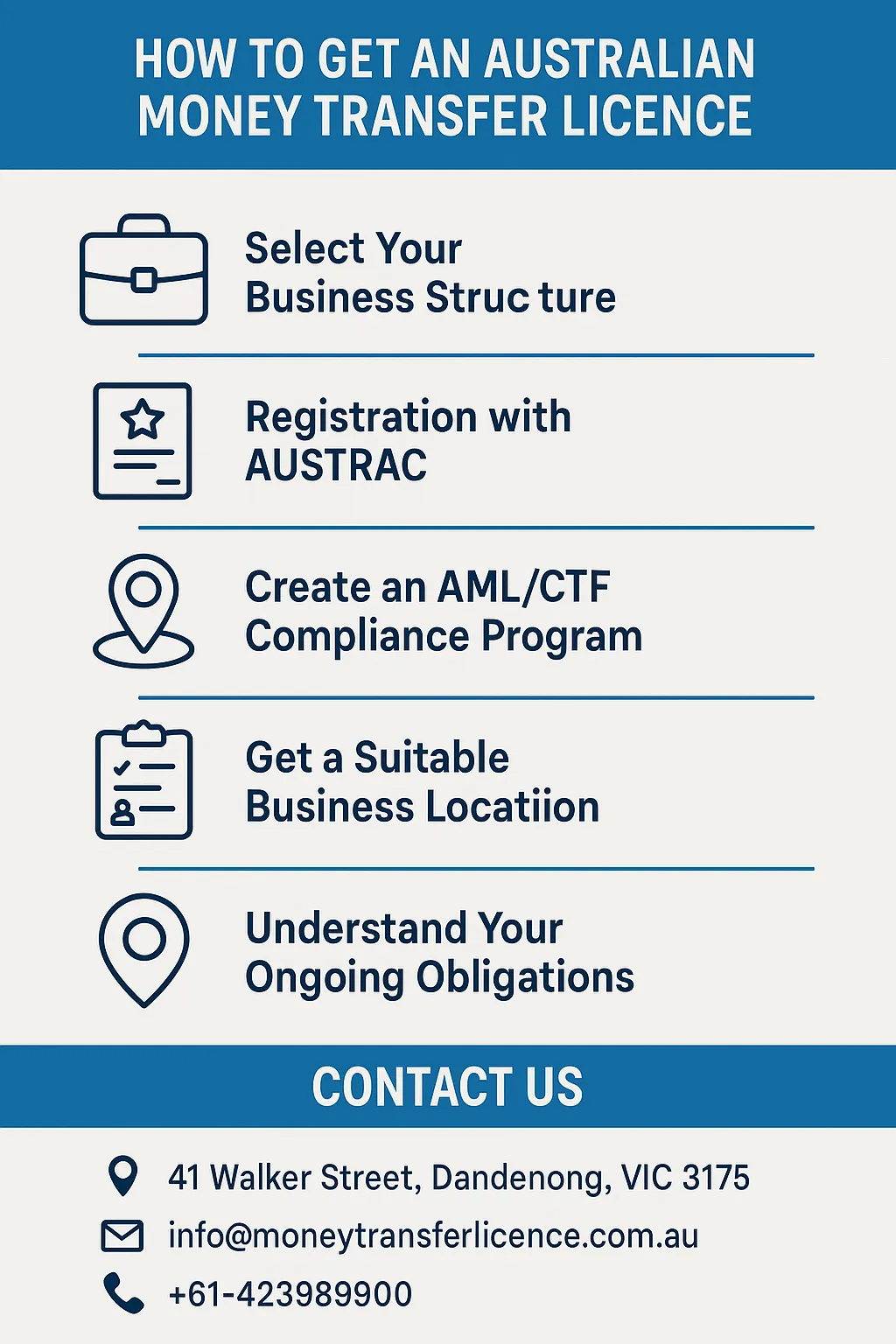
Step 2: Choose the Right Licence Structure
Once you’ve confirmed you need to register, the next decision is choosing the most appropriate business structure for your remittance operations. In Australia, there are two primary models:
Independent Remittance Dealer
Operating as an independent remittance dealer means you take on full regulatory responsibility. You must manage your own AUSTRAC registration, maintain your own AML/CTF compliance program, and be directly accountable for all reporting obligations. This structure is common for established operators with the resources to manage compliance internally.
Affiliate of a Remittance Network Provider (RNP)
Alternatively, you can operate as an affiliate under a registered Remittance Network Provider. In this model, the RNP assumes some compliance oversight, which can reduce your administrative burden. However, it also limits your operational independence and may affect your revenue share arrangements.
Choosing the right structure has a direct impact on your compliance obligations, cost base, and scalability. For tailored guidance on selecting the right model for your circumstances, read: How to Choose the Right Money Transfer Licence for Your Business
Step 3: Register with AUSTRAC
AUSTRAC (the Australian Transaction Reports and Analysis Centre) is Australia’s financial intelligence agency and the primary regulator for money transfer businesses. All remittance dealers must complete both enrollment and registration with AUSTRAC before providing any services.
AUSTRAC Enrolment vs. Registration
Enrolment is the initial step, where you formally notify AUSTRAC that you are a reporting entity. Registration is a separate, more detailed process specific to remittance dealers and digital currency exchange providers.
Key Documents Required
- Proof of identity for all beneficial owners and key personnel
- Details of your business structure (ABN, ACN, trust deed where applicable)
- Information about the nature and geographic scope of your remittance services
- Details of any agents or affiliates operating under your licence
Processing Timelines
AUSTRAC registration can take several weeks to process, depending on the complexity of your application and the completeness of your documentation. It is advisable to begin the registration process well in advance of your planned launch date.
Step 4: Develop an AML/CTF Compliance Program
One of the most critical — and often underestimated — requirements for registered remittance businesses is the development and implementation of a comprehensive Anti-Money Laundering and Counter-Terrorism Financing (AML/CTF) compliance program.
Your AML/CTF program must address the following core components:
- Risk Assessment: Identify and assess the specific money laundering and terrorism financing risks your business faces, taking into account your customer base, transaction types, geographic exposure, and delivery channels.
- Know Your Customer (KYC) Procedures: Implement customer identification and verification procedures that comply with AUSTRAC’s requirements, including enhanced due diligence for higher-risk customers.
- Transaction Monitoring: Establish systems to detect unusual or suspicious activity across your transactions, with clear escalation and investigation processes.
- Reporting Requirements: Understand your obligations to submit Suspicious Matter Reports (SMRs), Threshold Transaction Reports (TTRs), and International Funds Transfer Instructions (IFTIs) to AUSTRAC.
Many businesses underestimate the complexity of building an effective compliance program.
Step 5: Meet Ongoing Compliance and Reporting Requirements
Registration is not a one-off event. Operating a money transfer business in Australia requires ongoing compliance with a range of reporting and record-keeping obligations.
- Suspicious Matter Reports (SMRs)- You must submit an SMR to AUSTRAC as soon as practicable after forming a suspicion that a transaction may be related to money laundering, terrorism financing, or other serious offences.
- Record-Keeping Obligations- Reporting entities must retain transaction records, customer identification documents, and AML/CTF program documentation for a minimum of seven years.
- Employee Training- All staff involved in remittance operations must receive regular AML/CTF training to ensure they can identify suspicious behaviour and understand their reporting obligations.
Risks of Operating Without Proper Registration
Operating a money transfer business without completing the required AUSTRAC registration is a serious criminal offence under Australian law. The consequences include:
- Financial Penalties: Civil penalties can reach into the tens of millions of dollars for significant breaches.
- Criminal Charges: Individuals may face personal criminal liability, including prosecution and imprisonment.
- Business Shutdown: AUSTRAC has the power to suspend or cancel your registration, effectively shutting down your operations.
- Reputational Damage: Regulatory action is a matter of public record, and the reputational impact can severely limit future business opportunities and banking relationships.
Common Mistakes to Avoid When Registering
Even well-intentioned businesses can fall foul of the registration process. The most frequent pitfalls include:
- Submitting Incomplete Documentation: Missing or insufficient documentation is one of the leading causes of application delays and rejections. Ensure all required identification, business structure details, and supporting documents are in order before lodging your application.
- Underestimating AML/CTF Obligations: Many operators believe that enrolment alone satisfies their compliance requirements. In reality, maintaining an effective, up-to-date AML/CTF compliance program is an ongoing legal obligation.
- Failing to Conduct Proper Risk Assessments: A risk assessment is the foundation of your compliance program. Superficial or outdated assessments leave your business exposed and may not satisfy AUSTRAC’s expectations during a compliance review.
- Not Seeking Professional Guidance: Australia’s regulatory environment for money transfer businesses is complex and evolving. Attempting to navigate the registration and compliance process without specialist advice significantly increases the risk of costly errors.
Facing Challenges With Money Transfer Services? Contact Our Experts
Registering a money transfer business in Australia requires more than completing an online form. It demands a thorough understanding of your legal obligations, a well-structured compliance program, and an ongoing commitment to meeting AUSTRAC’s reporting and record-keeping requirements.
The regulatory framework exists to protect the integrity of Australia’s financial system and prevent it from being exploited for money laundering or terrorism financing. Businesses that take compliance seriously from the outset are far better positioned to build long-term operational sustainability and maintain access to banking and payment infrastructure.
For the best outcome, consider working with experienced money transfer licence providers who understand the specific licensing and other requirements for money transfer businesses in Australia. To simplify your licensing journey, contact us today and start your money transfer business.
FAQs About Guide to Registering Your Money Transfer Business
Yes. Most countries require formal licensing or registration before legally operating a money transfer business. This may include federal registration and state or national licensing, depending on jurisdiction. Operating without approval can lead to penalties, fines, or business closure.
An MSB (Money Services Business) registration is typically a federal classification covering various financial services. A money transmitter licence is usually state-specific approval to transfer funds on behalf of customers. In some countries, businesses require both to operate legally.
Timelines vary by jurisdiction. Some registrations may take a few weeks if documentation is complete, while others—particularly state-level applications—can take several months to a year. Delays often occur due to incomplete applications or compliance documentation issues.
Most regulators require proof of incorporation, a detailed business plan, AML/CTF policies, identity checks for directors, financial statements, and compliance procedures. Some jurisdictions also require appointing a compliance officer and submitting evidence of KYC frameworks.
Yes. Businesses providing remittance services in Australia must register with AUSTRAC before commencing operations. Registration is mandatory under AML/CTF laws, and ongoing compliance obligations apply, including reporting and maintaining an effective compliance program.
Generally, no. Most licences are jurisdiction-specific and do not grant cross-border authority. Businesses expanding internationally usually need additional licences or partnerships in each target country to comply with local financial regulations.
Ongoing obligations typically include maintaining AML/CTF programs, submitting transaction reports, retaining customer records, conducting audits, training staff, and notifying regulators of significant business changes. Failure to comply can result in fines or licence suspension.
Costs vary widely by country and state. Expenses may include application fees, surety bonds, legal support, compliance software, and ongoing reporting costs. In some jurisdictions, total setup and compliance expenses can reach tens of thousands of dollars.
Operating without required licences can result in severe penalties, including fines, business shutdown, asset seizure, and potential criminal charges. It may also damage your reputation and prevent access to banking partnerships or payment processors.
Engaging a compliance consultant or financial services lawyer can reduce application errors, speed up approval, and strengthen your regulatory framework. While it adds upfront cost, professional guidance often prevents costly compliance mistakes later.